
Why creatine deserves a closer look:
Creatine is one of the most thoroughly studied supplements in existence, and recent research suggests it may help far more people than gym athletes.[1] New reviews published in 2024 and 2025 examine strength, healthy aging, memory, women's health, and kidney safety.[3][5][8][12][18]
Patients ask us the same questions again and again: Does it work? Is it safe for me? How much should I take? Which brand can I trust? This post answers each one using the best published evidence, and tells you plainly where that evidence is still thin.
What creatine is and how it works:
Creatine is a compound your body makes and stores, mostly in muscle, that helps regenerate quick energy during short, hard efforts like lifting, sprinting, or climbing stairs.[1] You need roughly 2–4 grams a day. About half is made by your body, and the rest comes from food or supplements.[2] Meat and fish supply about 1–2 grams of creatine per pound.[2]
Taking creatine as a supplement raises the creatine stored in your muscles, which is the main reason it improves high-intensity performance and training results.[1] Brain cells use creatine too, which is why researchers have begun testing its effect on memory and thinking.[8]
What the evidence says creatine can do:
Short version: researchers are testing whether creatine can help the brain recover after injury, but it is too early to say it helps with concussion. The few human studies are small, and most involve children with more serious head injuries than a typical concussion.
Why researchers are curious: The brain uses a lot of energy, and head injuries disrupt how brain cells make it. Animal studies suggest creatine may soften some of that effect, which is what prompted the human trials.[33]
What the human studies show: In a 2006 pilot study, 39 children and teens (ages 1 to 18) with traumatic brain injury were randomly assigned to take creatine daily for six months or not. The creatine group had a shorter stretch of post-injury amnesia, shorter intensive care stays, and better recovery scores, with no side effects reported.[30] The same research group later reported improvements in headache, dizziness, and fatigue in a second small pilot.[31] Both were early studies, and the 2006 trial was open-label, meaning everyone knew who was taking creatine. The authors themselves called for larger, blinded trials.[30][31]
What about adults? A small randomized pilot trial tested creatine in adults whose symptoms lingered months after a concussion. After eight weeks, symptom scores did not differ significantly between groups. The main finding was that a trial like this is workable, and the authors say larger studies are needed.[33][34]
The big picture: A 2025 scoping review searched the literature on creatine and concussion in contact-sport athletes and found only four studies that met its criteria. Two were animal studies and two involved athletes, and the authors described the evidence as limited.[32] A hospital evidence-review team that looked for human studies on creatine and concussion concluded that no recommendation could be made for or against it.[35]
What this means for you: Creatine is not a concussion treatment. If you may have had a concussion, get evaluated, rest as advised, and return to activity gradually with your care team. Creatine is not a substitute for any of that. If you already take it for training, there is no evidence here that you need to change anything. Ask your clinician before adding it to a concussion recovery plan, and be cautious with online articles that promise faster concussion recovery, since the research does not yet support that claim.
Is creatine safe? Who should be careful:
Short version: creatine is safe for most healthy people, but "safe for everyone" is too strong. A few groups should check with a clinician first.
Healthy adults: The International Society of Sports Nutrition (ISSN) concluded that short- and long-term creatine monohydrate use, at trial doses up to 30 g a day for up to 5 years, showed no compelling evidence of harm in healthy people.[1] A 2025 expert paper counted more than 680 trials and 12,800 participants without clinical adverse events. That paper is an opinion article rather than a systematic review, and several authors disclose ties to the supplement industry.[2]
Kidneys: Creatine raises a blood marker called creatinine slightly, because creatinine is what creatine breaks down into. A 2025 meta-analysis of 21 studies found a small rise in serum creatinine but no significant change in glomerular filtration rate (GFR), the real measure of how well the kidneys filter.[12] Tell your doctor you take creatine before any blood work, because it can skew creatinine-based kidney tests.[13]
If you have chronic kidney disease, a history of acute kidney injury, one kidney, a kidney transplant, or protein or blood in your urine, talk with your doctor before starting.[13] Evidence in kidney disease is limited and concerns persist, so the decision should be individualized with your nephrologist.[14]
Hair loss and bloating: The hair-loss worry traces back to a 2009 study that measured the hormone DHT but never looked at hair. A 12-week randomized trial in 38 resistance-trained men taking 5 g a day found no difference from placebo in DHT or in hair measures.[15] Some people do notice a small early rise in scale weight, mostly water held inside muscle.[16]
Women's health:
Women generally start with lower creatine stores than men, and research on women has lagged behind.[17] A 2025 review found that supplementation strategies do not appear to differ much between men and women, and that emerging evidence suggests benefits after menopause, especially with resistance training. Data on perimenopause remain limited.[18]
Why women may have more to gain: Women tend to have less muscle mass and, on average, eat less red meat and fish, the main food sources of creatine. That means many women start with lower creatine stores than men.[17] Researchers think this could make supplementation matter at least as much for women, but studies that include women are still catching up.[17][18]
Bones after menopause: Bone loss speeds up after menopause, so researchers have tested whether creatine plus strength training can protect bones. The answer so far is "a little, but not the way social media says." A one-year study of 33 postmenopausal women found that creatine plus supervised lifting preserved about 3.4% of bone density at the femoral neck, the part of the thigh bone just below the hip joint.[36] A larger, longer trial followed: 237 postmenopausal women (average age 59) did resistance training and walking for two years while taking either creatine (0.14 g per kg a day, roughly 10 g for most women, which is more than the usual 3–5 g) or a placebo.[36] Creatine did not change bone density at the hip or spine, but it did improve some measures of bone strength at the narrow part of the femoral neck.[36] The takeaway: creatine may improve how bone is built, but it has not been shown to stop bone density loss. Strength training, protein, calcium, vitamin D, and your doctor's guidance on bone health still come first.
Mood: In one eight-week trial, 52 women with major depression took the antidepressant escitalopram plus either 5 g of creatine a day or a placebo. The creatine group improved sooner (a difference showed up by week 2), and about half were in remission by week 8 (52%) compared with about a quarter of the placebo group (26%).[37] Researchers think this may relate to how brain cells handle energy, but that is still a hypothesis.[37] This is promising, but it is a single small trial. It enrolled Korean women who were mostly experiencing a first episode of depression and had not been treated before, and an accompanying editorial cautioned that the findings need to be repeated in broader groups.[38] Blood creatinine also rose in the creatine group.[37] Creatine is not a replacement for antidepressants or mental health care, so if you take medication, talk with your prescriber before adding it.
Sleep loss and thinking: Two small lab studies tested a single large dose of creatine during a night without sleep. In one, 29 healthy adults who took 0.2 g per kg (about 14 g for a 70 kg adult) held up better on thinking tasks during 21 hours awake, with about a 12% smaller drop in performance, according to a news summary.[39][41] An earlier study of 15 young adults using 0.35 g per kg (about 24.5 g for a 70 kg adult) showed a stronger effect.[40] These studies included men and women and were not designed around women's health, and these one-time doses are far above the 3–5 g daily amount. It is an interesting lead, not a reason to megadose, and sleep itself is still the best fix.
What this means for you: A standard 3–5 g daily dose combined with strength training is the best-supported way for women to use creatine. Bone, mood, and sleep-related benefits are promising but early, so think of them as possible extras rather than reasons to take it.
Pregnancy and breastfeeding: where the research is heading

This is one of the most interesting areas of creatine research, and one of the least studied. Creatine is a normal part of your body's chemistry, and it shows up naturally in food and in infant nutrition.[2] Researchers are now exploring whether creatine could support mothers and babies during pregnancy and early life, and the early signs are promising.[2][18]
What we know so far: In animal studies, creatine has protected the fetus during low-oxygen stress, with no harm seen in mothers or offspring.[19] Early human research is beginning to follow.[18]
What we don't know yet: No randomized trials have tested creatine supplements in pregnant people. Pregnancy also changes how the body handles many nutrients, so results from non-pregnant adults may not carry over.[19] For that reason, creatine is not yet part of routine prenatal care.[19] We also found no studies measuring how much supplemental creatine passes into breast milk, so guidance for nursing is still catching up.
What this means for you: If you are pregnant, trying to conceive, or nursing, creatine is not a hard no. It is a decision to make with your care team. Bring it up with your OB-GYN or midwife, and know that meat and fish already supply creatine naturally.[2] If you were taking creatine before pregnancy, ask your provider whether to continue.
Children and teens:
The ISSN considers creatine monohydrate acceptable for young athletes who are in serious, supervised training, eat a balanced diet, and stay within recommended doses. It also notes that "under 18" label warnings are likely precautionary.[1] Reviews of adolescent use report no clinically significant adverse effects, but long-term data are limited.[20] Food comes first, and a teen should talk with a pediatrician before starting.
How much should you take?
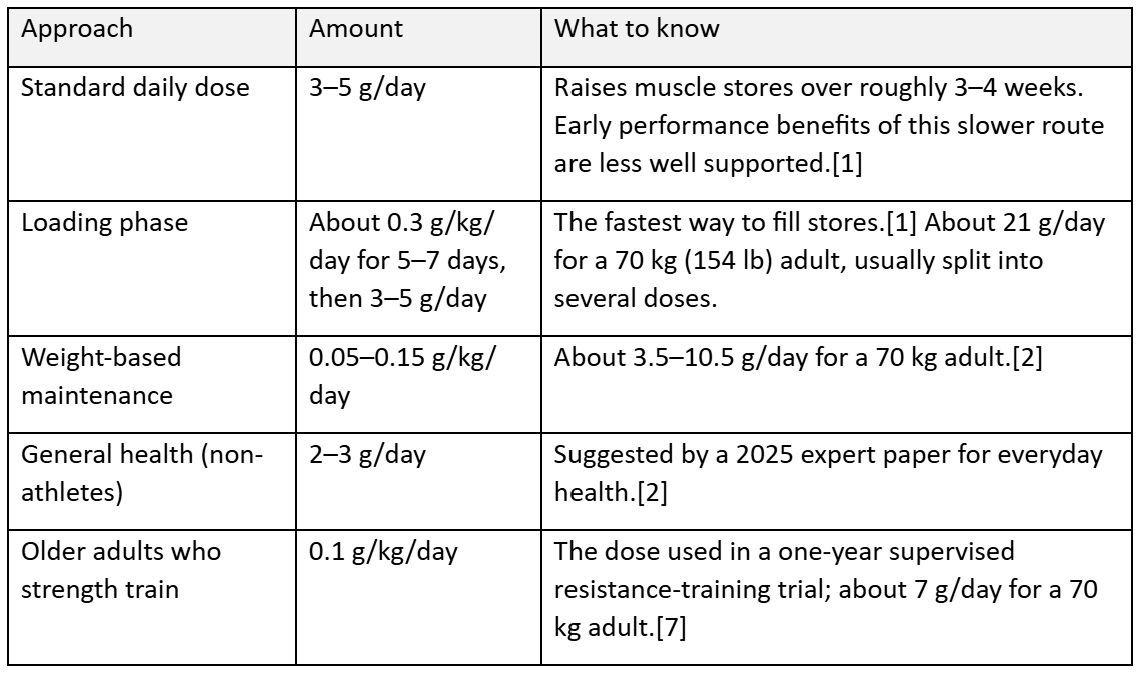
Short version: 3–5 grams of creatine monohydrate a day is enough for most adults. A loading phase is optional, and more is not better.
More is not better:
The 2025 PeerJ meta-analysis found that low-to-moderate doses outperformed high doses for strength.[4] Researchers have given far larger amounts in trials without finding compelling evidence of harm, but there is no reason to go there.[1]
Practical tips:
Take it every day, including rest days. The goal is to keep muscle stores topped up, which is what a 3–5 g daily dose does.[1]
Mix it into anything. Water, juice, a smoothie, or yogurt all work. Taking it with carbohydrate, or carbohydrate plus protein, may increase muscle uptake, but the performance benefit may not exceed creatine alone.[1]
Expect weeks, not days. Without loading, give it about a month before judging whether it is helping.[1]
Pair it with training. Most of the benefits above came from creatine combined with resistance exercise.[3][7]
Don't overpay. In ConsumerLab's 2026 testing, 5 grams of creatine monohydrate cost anywhere from about 13 cents to $1.85, and higher price did not mean higher quality.[21]
Which creatine is the best?
Short version: the best-supported form is plain creatine monohydrate, and the best brand is one that independently proves what is in the tub. No honest source can crown a single universal winner, because quality varies by batch and the most detailed brand rankings sit behind paywalls.
The form: monohydrate wins
The ISSN calls monohydrate the most effective and most extensively studied form.[1] Creatine ethyl ester, buffered creatine, and creatine citrate have not shown greater muscle retention than monohydrate.[1] Hydrochloride (HCl) has far less research behind it and cannot be called superior until it is compared directly in more experiments.[25] Newer, pricier forms have not been shown to be better.
The brand: look for proof, not hype
In June 2026, ConsumerLab, an independent testing company, bought and tested about a dozen popular creatine products. Most met quality standards. One failed because its creatinine level, a marker of degraded creatine, exceeded the limit.[21] ConsumerLab's Top Pick is available to its paying members rather than in public.[21]
Here is what a trustworthy tub looks like:
One ingredient. Creatine monohydrate, about 5 g per serving, with no proprietary blend or add-ins.[26]
A third-party seal you can verify. Look for NSF Certified for Sport, Informed Sport, or USP, and look the product up on the certifier's website. The FDA does not require testing for inadvertent contamination of ingredients with banned substances, so these programs fill a real gap.[22] NSF also tests for heavy metals, pesticides, and microbial contamination on top of roughly 280 banned substances. Informed Sport screens for more than 250 banned substances.[23]
Published purity numbers. The widely used Creapure raw material specifies at least 99.9% creatine monohydrate, creatinine at or below 100 mg/kg, dicyandiamide at or below 50 mg/kg, dihydrotriazine at or below 3 mg/kg, and lead, cadmium, mercury, and arsenic at or below 0.1 ppm.[24] Any brand can publish comparable numbers or a certificate of analysis. One that won't is telling you something.
A price that makes sense. Cost did not predict quality in ConsumerLab's testing.[21]
As one example, review sites list Thorne Creatine, a single-ingredient monohydrate, as NSF Certified for Sport.[26] Certification applies to specific products and can change, so confirm it in the certifier's directory before you buy.
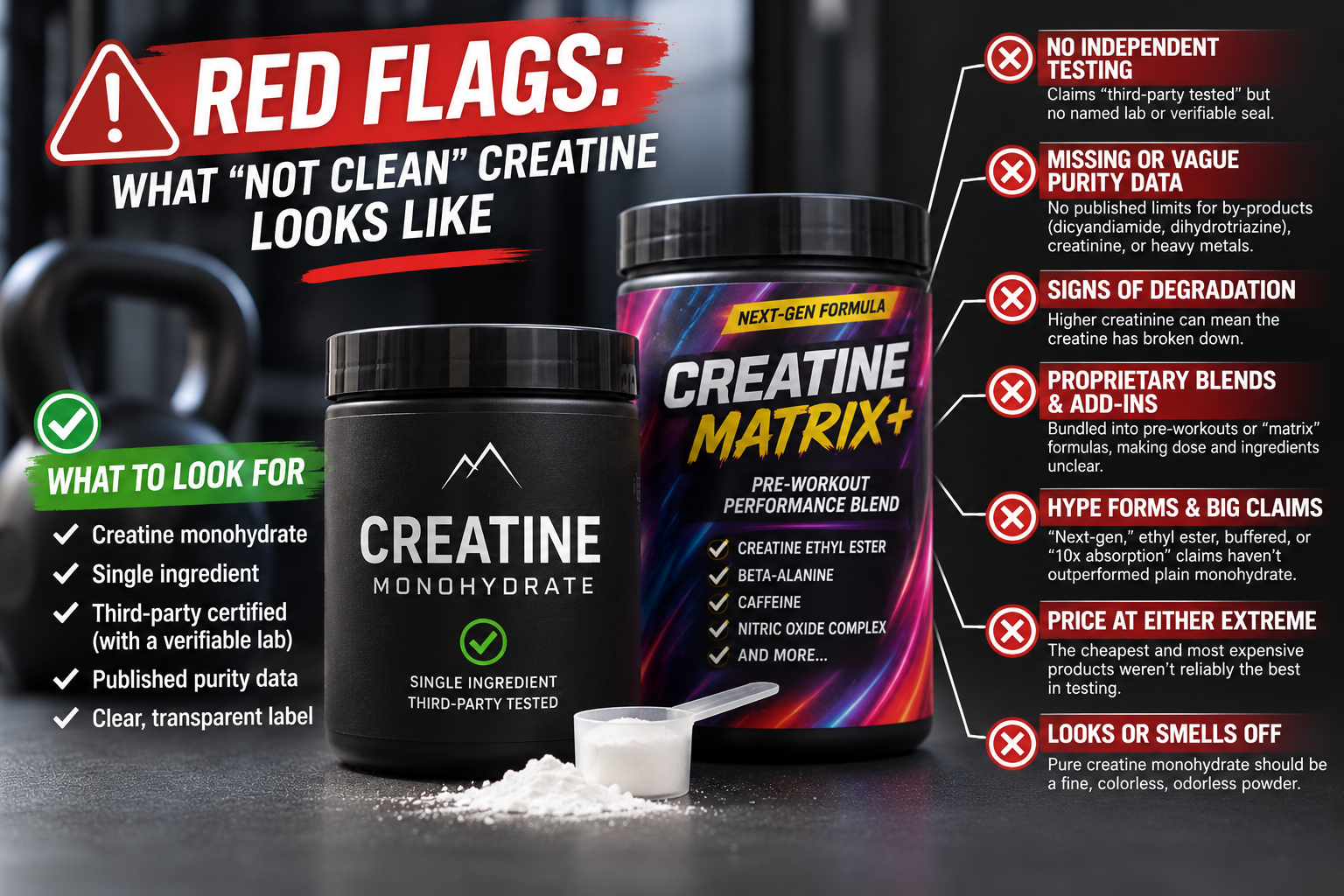
Red flags: what "not clean" creatine looks like
Short version: be wary of anything that can't show a lab result, adds a long ingredient list, or sells a "next-generation" form at a premium.
No independent testing. "Third-party tested" with no named lab, certificate, or searchable seal means little. Look for a certification you can verify.[22][23]
Missing or vague purity data. Quality makers publish limits for synthesis by-products (dicyandiamide, dihydrotriazine), creatinine, and heavy metals.[24]
Signs of degraded creatine. Creatinine is the marker ConsumerLab used to fail a product.[21] You can't see it at home, which is another reason to buy certified.
Proprietary blends and add-ins. Creatine bundled into pre-workouts or "matrix" formulas makes it hard to know your dose or what else you are taking. A single-ingredient product keeps it simple.[26]
Hype forms and big claims. Ethyl ester, buffered, and other "advanced" forms have not beaten plain monohydrate.[1][25] Be skeptical of "10x absorption" or "no loading, no bloating" claims.
Price at either extreme. Neither the cheapest nor the most expensive products were reliably the best in testing.[21]
Anything that looks or smells off. Manufacturer specifications describe pure creatine monohydrate as a fine, colorless, odorless powder.[24] If yours is discolored or smells unusual, don't use it.
Gummies vs powder:
Short version: powder is the safer bet. Company-run tests found that some creatine gummies contain little or no creatine, and gummies cost more per dose.
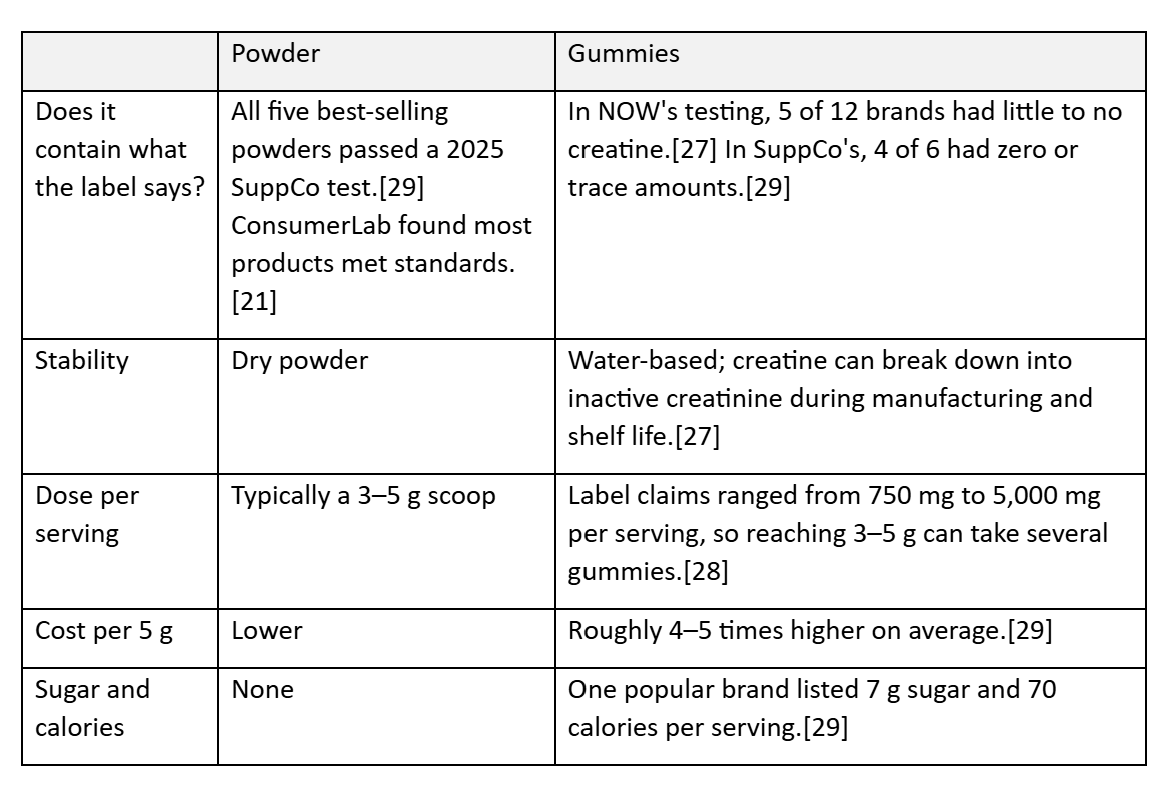
How much weight to give these tests:
The NOW and SuppCo results come from supplement companies and have not been peer reviewed. The samples were small, and some gummies did fine: 7 of 12 in NOW's testing met their label claims.[27] Two gummies in SuppCo's testing exceeded their label claims but showed creatinine levels suggesting the creatine was degrading.[29] NOW also reported that none of its usual outside labs could test the gummies, so the category may be under-tested.[27] ConsumerLab's 2026 testing included at least one gummy product. It did not publicly say which format the failed product was.[21]
If you prefer gummies:
Choose one with a verifiable third-party seal, confirm the label delivers 3–5 g of creatine monohydrate per daily serving, and keep it sealed and away from heat. If you want certainty about your dose, powder is the better choice.
The bottom line:
Creatine monohydrate is one of the best-supported supplements available. It gives modest strength and muscle gains alongside resistance training,[3][4] with early but promising evidence for memory.[8] Research on concussion recovery is very preliminary, and creatine is not a concussion treatment.[32][35]
Take 3–5 g a day. Loading is optional, and higher doses have not been shown to work better.[1][4]
Choose a single-ingredient monohydrate with testing you can verify.[22][23]
Start with powder. Be skeptical of gummies unless they are third-party certified and deliver a full dose.[27][29]
Talk to a clinician first if you have kidney disease, are pregnant or breastfeeding, or are under 18.[1][13][19]
Creatine supports training. It does not replace it.
This article is for education and is not medical advice. Supplements affect people differently. Talk with your physician or physical therapist about whether creatine fits your health history and goals. Last reviewed November 2026.
Dr. Bree Martin, PT, DPT
Frequently Asked Questions
1. How much creatine should I take daily?
For most adults, 3–5 grams of creatine monohydrate per day is enough. Taking it consistently is more important than timing, and a loading phase is optional.
2. Is creatine safe to take every day?
Research suggests creatine is safe for most healthy adults when taken at recommended doses. However, individuals with kidney disease, chronic health conditions, or those who are pregnant or breastfeeding should consult their healthcare provider before supplementing.
3. Does creatine help with anything besides muscle growth?
Yes! Emerging research suggests creatine may also support memory, cognitive processing, healthy aging, and muscle preservation. Some benefits are still being studied, but the strongest evidence supports improved strength and muscle gains when combined with resistance training.
References
Kreider RB, Kalman DS, Antonio J, et al. International Society of Sports Nutrition position stand: safety and efficacy of creatine supplementation in exercise, sport, and medicine. J Int Soc Sports Nutr. 2017;14:18. Full text
Kreider RB, Jagim AR, Antonio J, et al. Creatine supplementation is safe, beneficial throughout the lifespan, and should not be restricted. Front Nutr. 2025;12:1578564. Opinion article; authors disclose industry ties. Full text
Kazeminasab F, Kerchi AB, Sharafifard F, et al. The effects of creatine supplementation on upper- and lower-body strength and power: a systematic review and meta-analysis. Nutrients. 2025;17(17):2748. PubMed
Zhang H, Lan T, Yan X, et al. Effects of creatine supplementation on muscle strength gains: a meta-analysis and systematic review. PeerJ. 2025;13:e20380. PubMed
Sharifian G, Aseminia P, Heidary D, Esformes JI. Impact of creatine supplementation and exercise training in older adults: a systematic review and meta-analysis. 2025. Full text
Creatine supplementation for optimization of physical function in the patient at risk of functional disability: a systematic review and meta-analysis. JPEN J Parenter Enteral Nutr. 2024;48(4):389–405. PubMed
Candow DG. Creatine supplementation and healthy ageing (summarizing Candow DG, Chilibeck PD, Gordon JJ, Kontulainen S. Med Sci Sports Exerc. 2021;53:2388–95). MySportScience, updated December 2025. Article
Xu C, Bi S, Zhang W, Luo L. The effects of creatine supplementation on cognitive function in adults: a systematic review and meta-analysis. Front Nutr. 2024;11:1424972. Full text
Hespel P, Op't Eijnde B, Van Leemputte M, et al. Oral creatine supplementation facilitates the rehabilitation of disuse atrophy and alters the expression of muscle myogenic factors in humans. J Physiol. 2001;536(3):625–633. DOI
The effect of creatine supplementation on strength recovery after anterior cruciate ligament (ACL) reconstruction: a randomized, placebo-controlled, double-blind trial. Am J Sports Med. 2004;32(2):383–388. Abstract
Souza Padilha C, Sanches Cella P, Rodrigues Salles L, Deminice R. Oral creatine supplementation attenuates muscle loss caused by limb immobilization: a systematic review. Fisioter Mov. 2017;30(4):831–838. Full text
Kabiri Naeini E, Eskandari M, Mortazavi M, Gholaminejad A, Karevan N. Effect of creatine supplementation on kidney function: a systematic review and meta-analysis. BMC Nephrol. 2025;26(1):622. PubMed
Scripps Health. Is creatine safe for your kidneys? Article
Pereira JP, Leal VO, Trigueira P, Borges NA, Cardozo LFMF, Mafra D. Creatine supplementation in patients with kidney disease: harm or benefit? Nephrol Dial Transplant. 2026 (narrative review). DOI
Lak M, Forbes SC, Ashtary-Larky D, et al. Does creatine cause hair loss? A 12-week randomized controlled trial. J Int Soc Sports Nutr. 2025. DOI
GoodRx Health. Does creatine cause hair loss? Here are the facts. Updated December 12, 2025. Article
Smith-Ryan AE, Cabre HE, Eckerson JM, Candow DG. Creatine supplementation in women's health: a lifespan perspective. Nutrients. 2021;13(3). Full text
Smith-Ryan AE, DelBiondo GM, Brown AF, Kleiner SM, Tran NT, Ellery SJ. Creatine in women's health: bridging the gap from menstruation through pregnancy to menopause. J Int Soc Sports Nutr. 2025. Full text
Pramanik P. Settling the creatine safety debate (summary of a 2025 Front Nutr review of common creatine safety concerns). News-Medical, December 3, 2025. Article
Jagim AR, Kerksick CM, Kreider RB. Creatine supplementation in children and adolescents. Nutrients. 2021;13(2):664. Full text
ConsumerLab. Creatine supplements review, news release, June 22, 2026. Release
Informed Sport. Supplement safety guide (US). PDF
Eurofins. Sports supplement purity: choosing a certification program. Article
Creapure creatine monohydrate technical dossier (AlzChem raw material; distributor copy). Cambridge Commodities. PDF
Healthline. Types of creatine. Article
Healthline. Best creatine supplements. Article
Natural Products Insider. NOW tests creatine gummies, finding almost half to be severely understrength (company testing reported February 2024). Article
Vitamin Retailer. NOW testing identifies creatine gummy failings. March 4, 2024. Article
The Barbell. Creatine gummies (reporting a SuppCo lab test of 5 powders and 6 gummies), October 31, 2025. Article
Sakellaris G, Kotsiou M, Tamiolaki M, et al. Prevention of complications related to traumatic brain injury in children and adolescents with creatine administration: an open label randomized pilot study. J Trauma. 2006;61(2). PubMed
Sakellaris G, Nasis G, Kotsiou M, Tamiolaki M, Charissis G, Evangeliou A. Prevention of traumatic headache, dizziness and fatigue with creatine administration. A pilot study. Acta Paediatr. 2008. Full text
Giraldo JE, Bonilla DA, Bedoya LF, et al. Neuroprotective effects of creatine supplementation in mild TBI management among contact sport athletes: a scoping review. J Int Soc Sports Nutr. 2025;22(Suppl 1):2533681. Full text
Creatine Monohydrate for Mild Traumatic Brain Injury: a randomised controlled pilot study (adults with persistent post-concussive symptoms). ClinicalTrials.gov NCT06644131. Registry record
Pilot study protocol of a randomized controlled trial for the potential effects of creatine monohydrate on persistent post-concussive symptoms. Front Neurol. 2023;14:1209548. Full text
Children's Mercy Office of Evidence Based Practice. Creatine supplement in concussions (critically appraised topic). PDF
Chilibeck PD, Candow DG, Gordon JJ, et al. A 2-yr randomized controlled trial on creatine supplementation during exercise for postmenopausal bone health. Med Sci Sports Exerc. 2023;55(10):1750-1760. PubMed
Lyoo IK, Yoon S, Kim TS, et al. A randomized, double-blind placebo-controlled trial of oral creatine monohydrate augmentation for enhanced response to a selective serotonin reuptake inhibitor in women with major depressive disorder. Am J Psychiatry. 2012;169(9):937-945. PubMed
Bioenergetics for depression: something different for depression (editorial accompanying Lyoo et al.). Am J Psychiatry. 2012. Article
Gordji-Nejad A, Matusch A, Hengstler L, et al. Single-dose creatine reduces sleep deprivation-induced deterioration in cognitive performance. Nutrients. 2026;18(8):1192. DOI
Gordji-Nejad A, Matusch A, Kleedorfer S, et al. Single dose creatine improves cognitive performance and induces changes in cerebral high energy phosphates during sleep deprivation. Sci Rep. 2024;14:4937.
NutraIngredients. Single-dose creatine may support cognition in sleep deprivation: study. April 21, 2026. Article